

Website Check or Relaunch: How to Make the Right Decision
Not every underperforming website needs an immediate full relaunch. These criteria will help you clearly distinguish between optimization and rebuilding.
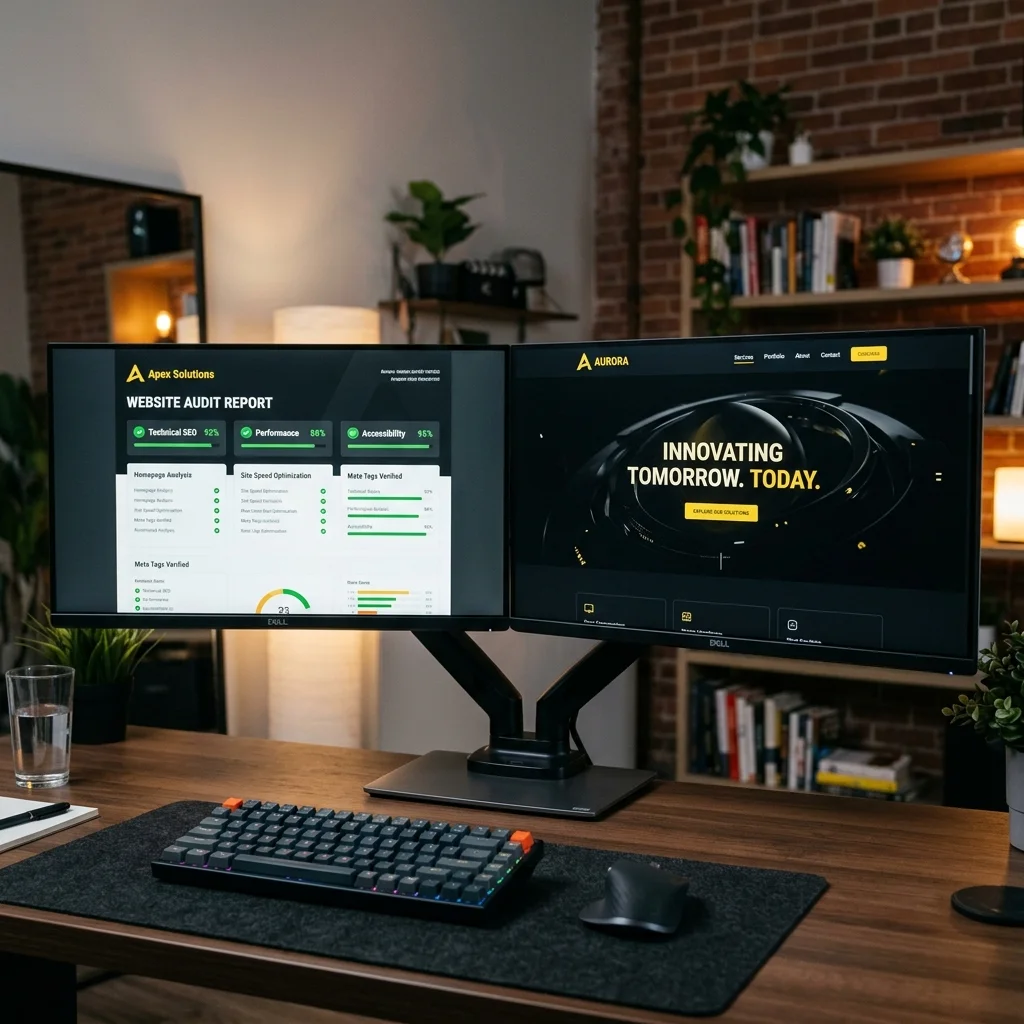
Many websites get rebuilt when targeted improvements would have been enough. Others get optimized for years, even though the structure, technology, or mobile experience has long been working against the business.
So the sensible first step isn’t a question about design preferences — it’s a sober decision: Which parts of your existing website are already working, and which ones are blocking inquiries?
A website check provides the foundation for this and often saves thousands of euros before a rebuild is even considered.
When Optimization Is Enough
Optimization makes sense when the technical foundation is solid and visitors can basically understand what’s being offered on the website. The biggest levers are usually in structure, copy, and contact flow.
Typical signals:
- the website loads inconsistently and performs poorly on mobile devices
- services are listed but not clearly prioritized
- contact options exist but appear too late or are too inconspicuous
- important questions about process, pricing, or service area are missing or buried
In this case, targeted revisions to the homepage, service pages, and calls to action can already create significantly more clarity — often for €300 to €800 and within one to two weeks.
Case Study: Schleifservice Weidemüller
A local sharpening service from Bavaria: the existing website was technically and structurally beyond repair. Outdated layout, no mobile view, services scattered unclearly across multiple subpages. Every individual optimization would have just meant another compromise.
The right decision here was a complete relaunch: new technical foundation, clear structure, mobile-first, with a landing page that shows at a glance what’s offered and how the customer can submit an inquiry (via phone or contact form).
Result: A clean, performant website that professionally represents the business today and works on every device. No patchwork — a foundation that will last for years.
Learn more: schleifservice.eu
When a Relaunch Makes More Sense
A relaunch becomes economically sensible when the existing website has too many structural limitations. In that case, every small improvement costs a disproportionate amount of time and still remains a compromise.
Typical signals:
- the layout works poorly or not at all on mobile
- content has grown over the years and can no longer be organized cleanly
- the offering has changed but the website doesn’t reflect it
- technical maintenance, load time, or extensibility are problematic
In that case, a new build is often not the fancier option but the cleaner path to a website that works for users and business goals again. A relaunch typically costs €2,000 to €6,000 and takes four to eight weeks — an investment worth making when the old foundation is truly in the way.
Optimization or Relaunch: The Decision Table
The following overview helps you categorize your own website:
| Criterion | Optimization Suffices | Consider Relaunch |
|---|---|---|
| Technical Foundation | The site loads stably and is technically easy to maintain. | System, performance, or maintenance bottlenecks slow down every change. |
| Mobile Display | Basic layout works; details and contact paths need fine-tuning. | Readability, navigation, or forms are fundamentally poor on mobile. |
| Offering & Content | The offering is right but needs clearer prioritization and explanation. | Services, target audience, or positioning have changed significantly. |
| Inquiry Path | Contact exists, but visibility and guidance are too weak. | The path to an inquiry is unclear, broken, or not built into the page flow. |
| Structure | Page logic works; individual sections need reordering. | Navigation, page structure, and content have grown organically over years. |
| Budget & Timeline | You need more clarity quickly and want to prioritize purposefully. | You want to create a solid new foundation for the coming years. |
| Risk | The biggest blockers can be removed without a complete rebuild. | Many small fixes would only layer new compromises on old problems. |
Several strong signals in the right column? Then a relaunch is more realistic than further individual optimizations.
The Better Decision Framework
A good website check separates three layers:
- Can visitors understand what’s offered within seconds?
- Can they quickly find the next logical step?
- Does the technical and design foundation support this path?
If the answer to two of these questions is fundamentally positive, optimization is usually worthwhile. If all three layers are shaky, a relaunch is more realistic.
This framework is deliberately kept simple. In practice, many business owners overestimate how well their website performs with new customers — they already know their own offering. The perspective shift from the customer’s point of view is the real value of a neutral website check.
What You Should Check Before Deciding
Don’t just check individual elements like colors, images, or buttons. What matters is the entire journey from first impression to inquiry.
Key areas to consider:
- Clarity at first glance – Can someone tell within 3 seconds what you do?
- Visible contact options – Is there a path to an inquiry on every page?
- Understandable service structure – Are offerings logically grouped, not just listed?
- Mobile readability – Does the site work on smartphones better than “it’s okay”?
- Trust through examples – Do you show references, results, or a price range?
- Technical speed and SEO basics – Does the page load quickly and is it optimized for search engines?
- GEO – Optimization for AI search engines – Is your website structured so that ChatGPT, Gemini, and other AI assistants can correctly capture and cite it as a source?
- Google Business Profile. Are you locally visible on Google? An optimized profile often delivers more than a new website.
These seven points cover around 80% of the typical blockers that cost you inquiries. A structured analysis of these points provides a clear answer within a few days.
Conclusion
A website doesn’t need to be constantly rebuilt. But it does need to be clear enough that the right visitors understand the value and can take action.
The best next step is therefore an honest analysis: improve purposefully if the foundation holds; rebuild if the foundation itself has become the problem.
If you’re unsure whether your website should be optimized or rebuilt, an honest analysis is the most sensible next step.